A non-canon species of my own creation
Story elements by me, art by DeivCalvez
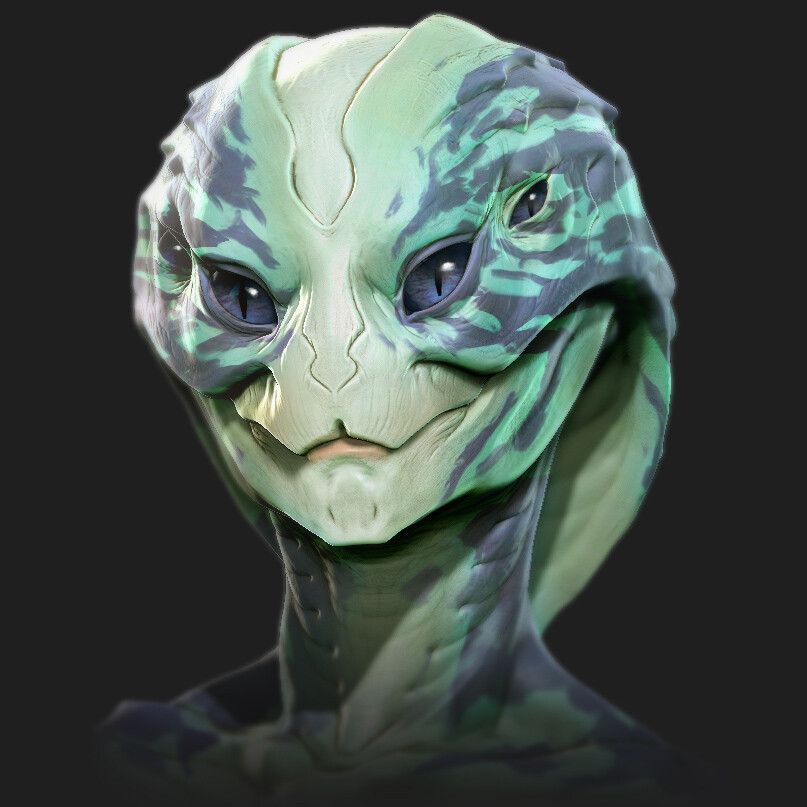
LTC. KRIXX
Chief Engineer/Second Officer
(they/them)
homeworld
The Siraxians are native to Sirax Prime, a planet of tropical forests, wetlands, and shallow seas. The planet has enjoyed Federation membership for nearly a century, but Siraxians rarely opt to join Starfleet.
physiology
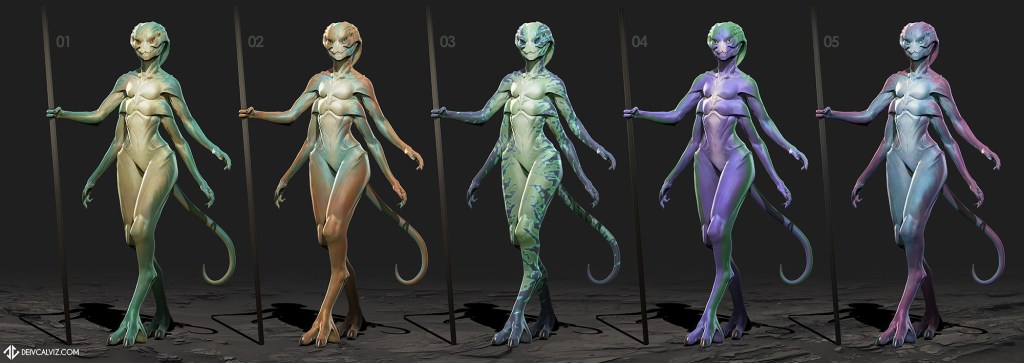
Siraxians are endothermic amphibians with four eyes, four arms, twelve fingers, and a tail. Adults average around seven feet (2m) in height. They possess a wide variety of skin tones, with greens and browns being more common among marsh dwellers and blues and purples denoting coastal ancestry. In addition, all members of the species have both gills (located in the neck) and lungs, allowing them to survive indefinitely on land as well as underwater.
Siraxians procreate via asexual reproduction, thus the species only has a single gender. During adulthood, a Siraxian’s body may spontaneously spawn an offspring that will be born live, and rely on their parent and community for survival for approximately twenty years. Barring accident, violence or disease, a Siraxian can live up to two centuries.
Siraxians can and do suppress the spawning process through artificial means, and have no stigmas attached to doing so.
Thanks to their second set of slitted eyes, Siraxians enjoy a larger field of vision, greater visual acuity, and better low-light vision than Humans.
history
Centuries ago, the uninhabited Sirax Prime was colonized by a mysterious species known only as the Makers. Arriving via generation ship, the Makers began transforming the untamed wilderness into a civilization that reflected their lost homeworld.
Masters of genetic engineering, the Makers used local fauna as a template to create a clone labor force, perfectly adapted to the planet’s natural environment. The cloning industry produced a wide variety of models, each manufacturer constantly upgrading their products in order to best their rivals.
Initially engineered to be sterile, the clones eventually began procreating on their own. Since it started with one specific make and model, it was considered a manufacturing defect. However, it soon came out that a geneticist named Korix had deliberately included that feature in the affected line.
In a panic, the Makers attempted to recall thousands of “defective” clones and their offspring in an attempt to undo Korix’s actions. The clones in question were separated from their offspring and confined in interment camps while the government debated their fate.
When the media learned that execution chambers had been installed in the camps, the clones rebelled enmasse, with support from sympathetic Makers. Fortunately, the camps were overrun and shut down before the genocide could begin.
Sweeping reformations followed, and the sale and manufacturing of clones was outlawed. The clones were legally defined as sentient beings and granted their freedom.
However, these reforms did not sit well with conservative Makers, and various political groups spent years resisting attempts at fully integrating clones into mainstream society. More extreme groups even resort to committing hate crimes against members of the clone community.
These conditions ultimately led to a civil war, with the clones and their allies fighting against what they saw as a tyrannical and oppressive regime. The war escalated out of control, with numerous bioweapons being deployed by both sides.
Two of the weapons had completely unexpected effects once combined, effectively sterilizing the Makers, while leaving their creations unharmed. By this point, Siraxian society had already completely collapsed into scattered settlements, and there was no one left who was qualified to reverse the situation. Eventually, the Makers died out, leaving their creations behind to inherit the planet.
Modern Siraxians are descendants of the clones, who rebuilt their civilization on the ruins left behind by the Makers. They eventually surpassed their creators when they unlocked the secrets of warp travel on their own, something the Makers had never accomplished.
Their first warp-capable cruiser left the Sirax system in the late 22nd century on a mission to locate the lost homeworld of the Makers. Much to their surprise, the encountered a Federation starship already investigating that particular planet.
Since they had abandoned genetic engineering centuries previously, and reproduced via natural childbirth, the Federation saw no reason to hinder Siraxian membership.
social life
Even though they don’t need to mate, Siraxians still form romantic attachments to one another. Adults often form partnerships with one or more close friends, choosing to share dwellings and pool their resources to support their offspring. Marriage contracts exist purely as a legal framework to define each partner’s rights and responsibilities. Household size varies depending on region and personal preference, and some homes contain multiple generations of the same bloodline.
As Federation citizens, Siraxian children have access to the same levels of education and learning facilities as any other member world. Some pursue higher education while others choose to end their formal education with vocational training. Afterwards, they may choose to either leave home to pursue a career or remain close to their family.
 Star Trek:Journeys